
Volcanism, mountain building, weathering, and erosion play first-order roles in dictating the chemical composition of the oceans and atmosphere. Thus, we strive to understand the integrative relationship between lithospheric processes, climate change, and biological evolution throughout Earth history.
Our work primarily consists of field-based projects that assess regional tectonic– sedimentary continental records in the context of global-scale changes in Earth's surface environment. As geological generalists, we take multidisciplinary, multiproxy approaches to decipher the stratigraphic archive. This includes detrital mineral geochemistry and geochronology, thermochronometry, chemostratigraphy, biostratigraphy, and/or whatever gets the job done!
Ijen volcanic crater, southern Java Indonesia
Research Themes — The stuff that keeps us up at night...
Volcanism, Mountain Building, and Climate
Tectonic processes play important roles in governing atmospheric chemistry by providing CO2 through volcanic outgassing and removing CO2 via chemical weathering and organic matter burial. Our research aims to understand:
—Regional-scale mountain building processes in various tectonic settings, e.g., the Andes, the Himalaya, and Southeast Asia
—How changes in plate tectonic processes, global-scale volcanism, and mountain building influence climate on multi-million year time scales.
—The utility of proxies for tracking weathering in Earth history.
—Mechanisms that enhance carbon burial in sedimentary basins

Relationship between arc-volcanism & icehouse-greenhouse transitions (McKenzie et al., 2016)

Influence of mafic-rock weathering on Cenozoic seawater lithium isotopes (Cheung et al., 2026)
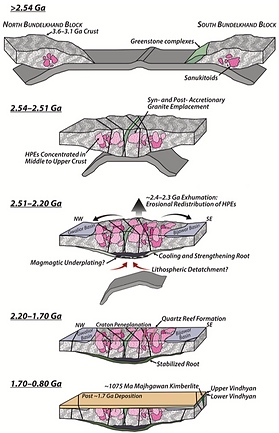
Formation & Stabilization of the central Indian Bundelkhand craton
(Colleps et al., 2021)
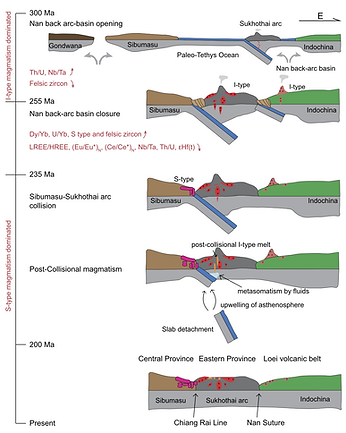
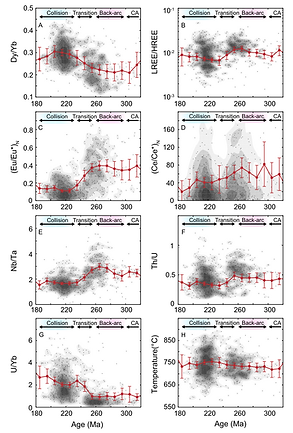
Using detrital zircon U-Pb isotopic and trace elemental compositions to track subducting slab dynamics and terrane accretion in Thailand (Liu et al., 2022)
Crustal Evolution
Like the long-term carbon cycle, many biogeochemical processes are linked to tectonic processes. This means that the onset of lateral plate tectonics and evolution of the continental crust may have first-order implications for the evolution of Earth's atmosphere, oceans, and biosphere. Thus, it is important to know how the continents formed and when plate tectonics, as we know it, initiated. We are broadly focused on:
—Constraining the compositional evolution of continental crust through Earth history
—Understanding the formation and long-term stability of continental interiors
—Refining the utility of detrital-mineral proxies for crustal processes
Biodiversity & Mass Extinctions
Earth has experienced numerous diversification and mass-extinction events. The relationship between these swings in diversity & changes in Earth's surface environment remains enigmatic. The 'Cambrian dead interval', a noted period of pronounced environmental stress characterized by numerous mass extinctions, intervenes two of the most dramatic diversification events in Earth history: The Cambrian 'explosion' and the Great Ordovician Biodiversification Event. We are interested inthe drivers responsible for climatic shifts associated with biodiversity.
—The transition from Cryogenian icehouse, which included the 'snowball Earth' events, into the Cambrian greenhouse.
—Environmental conditions during Cambrian trilobite mass extinctions events.
—Impact of Late Paleozoic icehouse–greenhouse transition on the Permian Earth-system


Revised record of earrly Eukaryotic biodiversification (Tang et al., 2024)
Relationship between early Paleozoic volcanism, climate and biodiversity (McKenzie et al., 2014; McKenzie & Jiang 2019)
$$$ FUNDING $$$
Hong Kong (HK dollars and [US dollars]) **there is no overhead deduction on HK grants**
2026-2027. PI. Dr. Stephen S.F. Hui Trust Fund: "Tracking the influence of volcanic CO2 outgassing on the Late Paleozoic Ice Age". HK$ 96,000 [~12,258 USD].
2024-2027. PI. RGC-GRF-Earth Sciences: Assessing geochemical records of Cenozoic intra-oceanic volcanic arc evolution along the western Pacific". $920,742 HKD [~$117,574 USD].
2023-2026. PI. RGC-GRF-Earth Sciences: “Investigating the timing and depositional record of Neoproterozoic Snowball Earth events in Australia”. $643,192 HKD [~$82,273 USD].
2023-2026. PI. HKU Seed Grant: "Investigating Permian mass extinctions in sedimentary successions of Southeast Asia". $62,026 HKD [~$7920 USD]
2022-2025. PI. RGC-GRF-Earth Sciences: “Was the Boring Billion really boring? Investigating biological and environmental co-evolution in late Paleoproterozoic to early Neoproterozoic strata of the North China Craton”. $870,000 HKD [~$110,973 USD].
2022-2024. PI. UCR-CRF Seed Funding: “Investigating the role of tropical Southeast Asia in the global carbon cycle.” $918,292 HKD [$117,125 USD].
2022-2025. Collaborator. RGC-Collaborative Research Fund (CRF): “Characterization of ancient lake basins on Mars using advanced topographic modelling and innovative spectroscopic techniques”. $5,809,600 HKD [~$745,261 USD]. Principal Coordinator J. Michalski.
2021-2023. PI. URC-PDF/RAP Scheme. Provides matching funds for postdoctoral support. Approximate value ~$400,000 HKD [~$51,500 USD].
2020-2022. PI. Teaching Innovation Award: “Digital scanning of petrographic thin sections for online teaching and learning” $100,000 HKD [$12,825 USD].
2020-2023. Co-PI. RGC-GRF-Earth Sciences:" Reconstructing the history of seawater sulfate and its role in the Phanerozoic Earth system" $665,512 HKD [$85,858 USD]. PI S. Crowe.
2019-2022. PI. HKU Budget Resource Committee (BRC) award for $10.5 million HKD [~$1.4 million USD] for new MC-ICP-MS and laser ablation system.
2019-2022. Lead PI. RGC-GRF-Earth Sciences: "Zircon geochemical characterization of East Asian volcanic arc dynamics". $558,272 HKD [$71,600 USD]
2019. HKU Excellence Fund. $1,000,000 HKD [$128,253 USD]
2019-2021. Lead PI. HKU Seed Grant: "Developing New LA-Split-Stream-ICPMS Techniques". $66,570 HKD [$8,484 USD]
2019-2020. Lead PI. Hung Hing Ying Physical Sciences Research Fund: "Statistical Evaluation of Volcanic Carbon Fluxes on the end-Permian Mass Extinction". $30,000 HKD [$3,823 USD].
2018-2021. Lead PI. RGC-GRF-Earth Sciences: "Multi-proxy investigation of Cambrian mass extinction events". $505,298 HKD [$64,382 USD]
2018–2019 Lead PI. HKU Seed Grant: "Calibrating zircon trace element data as a proxy for crustal processes“. $95,190 HKD [$12,126 USD]
2018 PI. URC Small Equipment Grant: "Acquisition of a Quadrupole ICPMS". $1,024,422 HKD [$130,508 USD]. Co-PI Christelle Not.
2018-2022. Co-coordinator. UNESCO-IGCP 668 “Equatorial Gondwanan history and Early Palaeozoic Evolutionary Dynamics”.
2017–2020 LEAD PI. RGC (Early Career)-Earth Sciences: “Multi-proxy geochemical and geo-/thermochronologic investigation of continental crust evolution through Earth history”. $600,557 HKD [$76,873 USD]
2017–2019 PI. HKU Seed Grant: “Source-to-sink evaluation of bedrock weathering”. $150,000 HKD[$19,200 USD]
United States (all in US dollars)
2015–2018 Lead PI. NSF-Tectonics: “Exhumation History of the Indian Lesser Himalaya:Discriminating Tectonic Models with Implications for the Neogene Isotopic Composition of Seawater”. Co-PIs D. Stockli & B. Horton. $361,773 USD. Collaborator A. Webb.
2014–2017 Co-PI. NSF-Tectonics: “Rapid Miocene thrust propagation and wholesale basin partitioning along the central and southern Andes, Argentina.” Co-PI: B. Horton. $298,481 USD.
2014 Co-PI. Jackson School Seed Grant: “Convergent-margin deformation and arc magmatism as triggers of early Paleozoic global extinctions and biodiversification”. Co-PI B. Horton. $25,000 USD.
2011–2013 Graduate student coauthor. NSF-Sedimentary Geology & Paleobiology. Collaborative Research: Testing Himalayan tectonic and erosional history via chronostratigraphic correlation between the Lesser Himalaya and Indian craton. PI N. Hughes. $180,189 USD. Collaborators P.Myrow, S. Xiao, and G. Jiang. Total awarded for project = $365,633 USD.
2013 NSF Critical Transitions Workshop Travel Support. $3,000 USD.